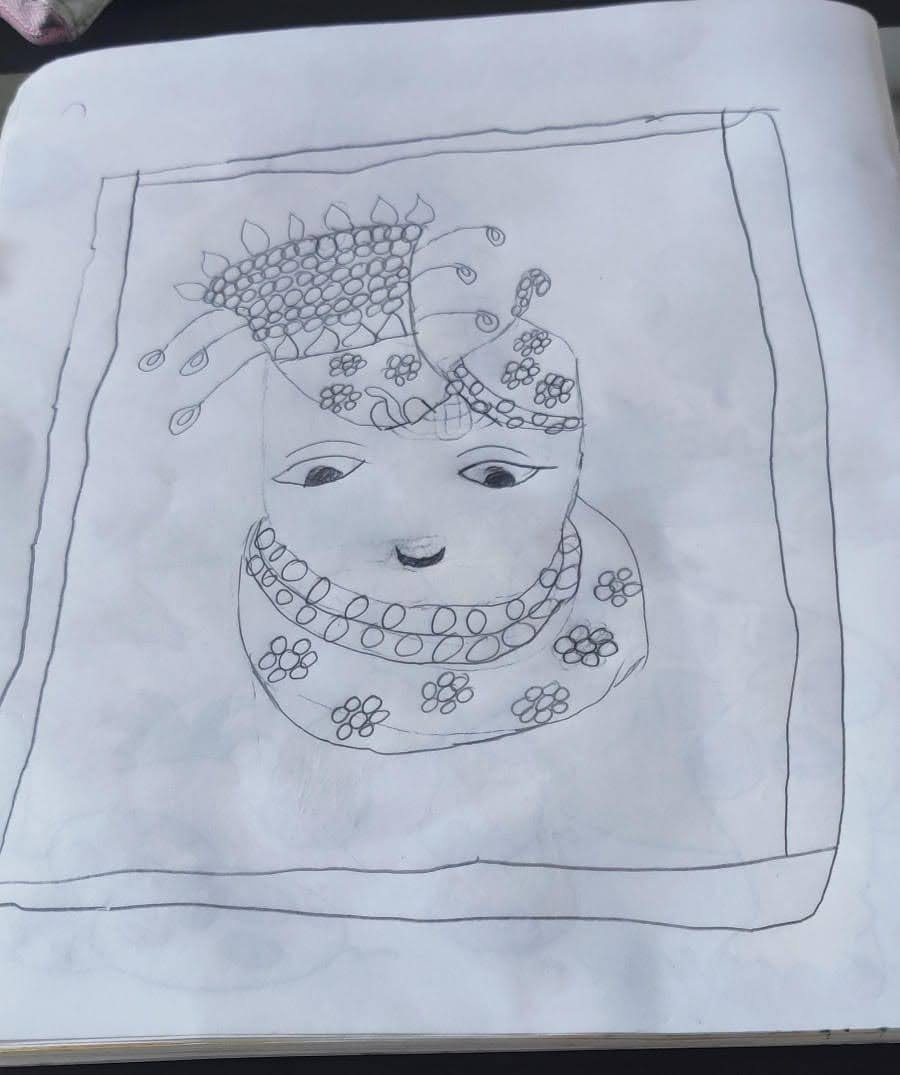
The Wikipedia page for Shrinathji starts by introducing him as a form of Hindu deity "Krishna", manifested as a seven year old boy who is traditionally portrayed with a somber look. However, with this drawing, the artist forces us to re-evaluate this traditional view. After all, how many seven year old boys are there who wear a grave look on their face? None! And yet quite ironically and tragically, we deprive our most revered god of this beautiful and worry-free childhood. In this drawing, the artist has successfully gives back that childish, carefree smile back to a boy; Even more, He is given a naughty smile, as is typical of seven year old boys! Shrinathji is finally smiling and enjoying his childhood. For this, I extend my kudos to the artist.
It is interesting to note that the artist also included the drawing of Shrinathji in a frame. I believe that in doing so, the artist is challenging our society to reimagine the concepts of power and reverence through a human lens. For example, why is it that most of drawings of Gods or prophets only show them in a grave expression? Is it really that idolization comes at cost of human emotions; And must it always be so? By having a frame around the drawing of Shrinathji, I believe that the artist is asking the society to realize that showing human emotions does not chip away at someone's greatness.
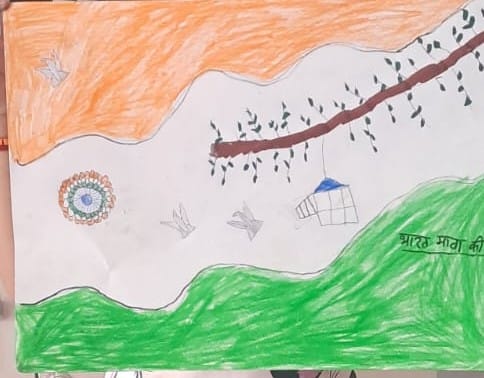
Due to India's geography of having the mighty Himalayas on the north, a common landscape image in Indian context is to have mountains, rivers and plains; And glimmering in bright sunlight! For example, check out the results from Google Image search of "Image of mountain and river in India context". Hence, it is common in Indian schools to have children draw landscapes with mountains, rivers and plains, like this one. However, the artist takes this common image and infuses national pride into it by seamlessly blending it with the Indian National Flag. If it's not obvious how this is happening, then try the following exercise: Start with the common landscape photo; Give it a saffron hued sky, like during morning or evening; Color the plains lush green, as if it is abundant with vegetation; Reimage the river bank on side of mountain as a branch having leaves, and supporting native birds (Of course because this side of river is more rugged and lines with trees, unlike the other side which is more likely to be used for agriculture. The primal forest is the one that supports wildlife and birds); Lastly, move the bright sun to over the mountains and express it as the Ashoka Chakra to get the wonderful, symbolic and extremely patriotic drawing made by the artist, reintegrating the Indian spirit back to the common landscape inspired by India.